State and Local Government
When most people think about government, they usually picture the president or Congress. For most Americans though, the government that has the most direct impact on their daily lives is much closer to home.
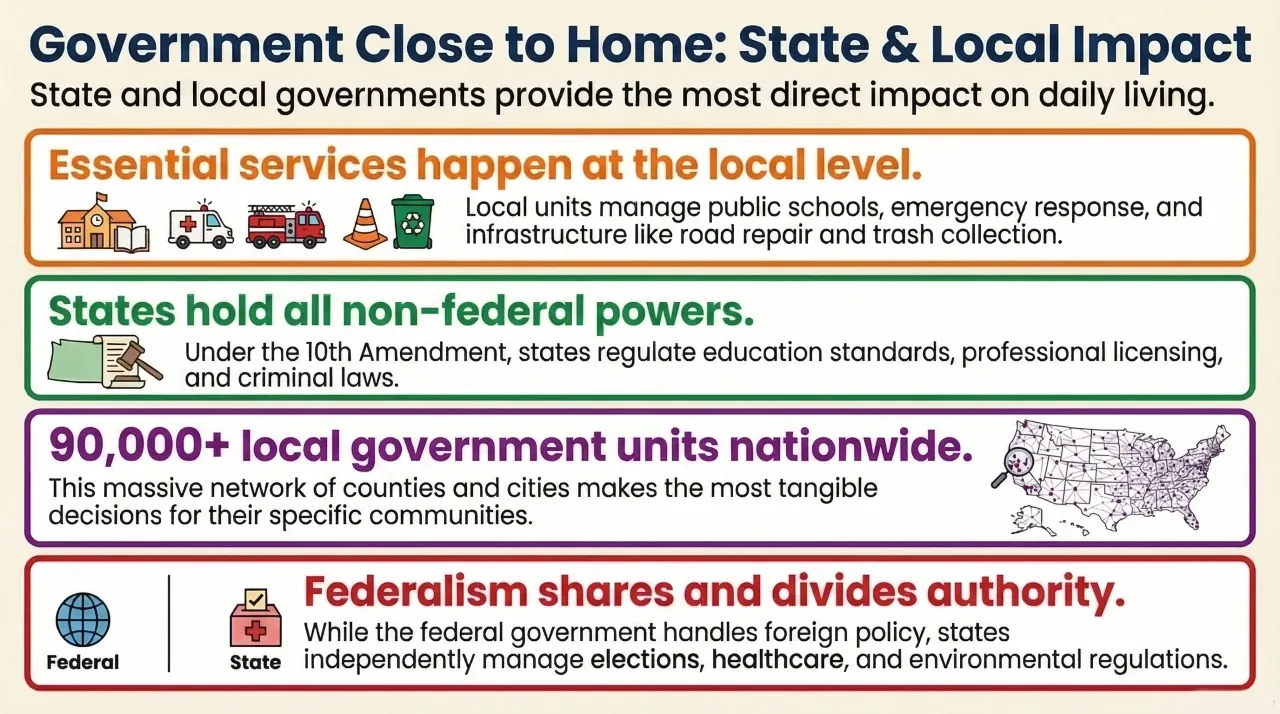
It's state and local governments that maintain roads, run public schools, staff police and fire departments, issue driver's licenses, and manage local parks and libraries.
In many ways, these governments touch people's lives more directly than the federal government ever does.
The Role of State Governments
The United States has 50 state governments, each with its own constitution, legislature, executive branch, and courts. They all are independent governing bodies with their own areas of authority.
Under the Tenth Amendment, any power not granted to the federal government and not prohibited to the states is reserved for the states or the people. This gives states broad authority over many of the most important aspects of daily life.
States set their own education standards and oversee public school systems. They establish and enforce their own criminal laws. They regulate businesses operating within their borders, license professionals like doctors and teachers, set speed limits, and manage their own court systems.
States also play a central role in running elections, even federal ones, since the Constitution leaves most details of election administration to the states.
Each state government mirrors the structure of the federal government in important ways. Every state has a legislature that makes state laws, a governor who heads the executive branch, and a state supreme court that serves as the highest court for state law.
Most states have bicameral legislatures with two chambers, though Nebraska is the only state with a unicameral, or single-chamber, legislature.
The Relationship Between State & Federal Government
State and federal governments share power in a system of federalism, but that relationship has never been perfectly smooth or clearly defined. Some powers belong exclusively to the federal government, like printing money and conducting foreign policy. Some belong exclusively to the states, like establishing local governments and conducting elections. Many others are shared, or concurrent, like the power to tax and build roads.
When state and federal law conflict, the Constitution's Supremacy Clause makes clear that federal law wins. But within their areas of authority, states have real independence. This means policies on issues like education funding, criminal sentencing, environmental regulation, and healthcare can vary significantly from one state to another, reflecting the different values and priorities of different state populations.
Local Governments
Below the state level sits a vast network of local governments. Counties, cities, towns, townships, school districts, and special districts all provide services and make decisions that affect the daily lives of residents. There are more than 90,000 units of local government in the United States, more than in any other country in the world.
Local governments are created by state governments and get their authority from the state. They do not have independent constitutional standing the way states do. A state can create, modify, or even dissolve a local government if it chooses. In practice, however, local governments operate with significant independence in managing the affairs of their communities.
The services provided by local governments are often the most visible and tangible parts of government in people's daily lives. When children go to school, when a pothole gets filled, when a fire truck responds to an emergency, when trash gets collected... these are all local government functions.
The decisions local governments make shape the character of communities in ways that national policy often cannot.