Regional Authorities and County Boards
Between state governments and the cities and towns most people are familiar with, there exists another layer of government that often goes unnoticed.
Regional authorities and county governments operate across broad geographic areas, providing services and making decisions that no single city or town could handle alone. They don't really make headlines, but these bodies play an essential role in keeping communities functioning.
What Are Regional Authorities?
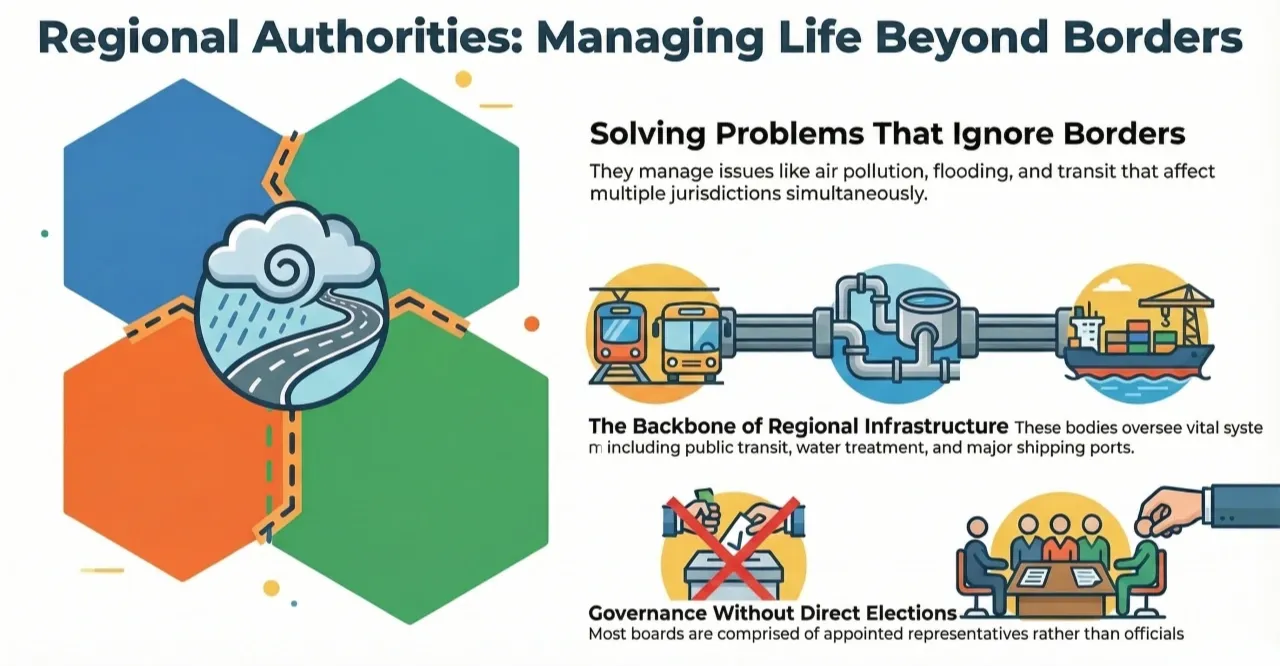
Regional authorities are governmental or quasi-governmental bodies created to manage issues that cross the boundaries of multiple cities, counties, or even states. They are established because some problems simply do not respect political borders.
A river that floods doesn't stop at a county line. Air pollution drifts across city limits. A regional transit system serves commuters from dozens of different municipalities. Regional authorities allow governments to coordinate and pool resources to address these shared challenges.
Examples of regional authorities include transportation authorities that manage bus and rail systems serving multiple communities, water and sewer authorities that manage regional water supplies and wastewater treatment, and port authorities that oversee shipping and transportation infrastructure.
The Port Authority of New York and New Jersey, for example, is a bi-state agency that manages airports, bridges, tunnels, and transit facilities across the New York metropolitan area. Regional planning commissions coordinate land use and development across multiple jurisdictions, helping communities think beyond their own borders when making decisions about growth and infrastructure.
Regional authorities are typically governed by boards made up of representatives from the participating governments. Because they are not directly elected by the public in most cases, regional authorities are sometimes criticized for lacking democratic accountability. Decisions that affect large numbers of people are made by officials who were not chosen by those people directly, which raises important questions about transparency and responsiveness.
County Governments
Counties are the primary unit of local government in most states, serving as the administrative arm of state government at the local level. There are more than 3,000 counties in the United States, ranging from tiny rural counties with a few thousand residents to enormous urban counties like Los Angeles County, which has a population larger than most states.
The governing body of a county is typically a board of commissioners or board of supervisors, elected by county residents. This board serves as both the legislative and executive authority for the county in many states, setting the county budget and overseeing county departments and services.
County governments typically provide a range of services that state governments require them to deliver. These include maintaining property records and conducting elections, operating county courts and jails, providing public health services, managing county roads and bridges, and running social services programs.
In rural areas where there may be no city government, the county is often the primary provider of nearly all government services residents receive.
The relationship between county government and the cities and towns within it can be complex. Cities generally have their own governments and provide many services independently. But even residents of cities rely on county services for things like courts, property records, and public health programs. In unincorporated areas, those outside any city or town limits, the county government is the only local government serving residents.