Independent City Government
Cities are the most familiar form of local government for most Americans. They are where millions of people live, work, and spend their daily lives.
The government that manages a city has a huge influence on what that experience looks like. From the quality of schools to the condition of parks and roads, city government shapes the urban environment in countless ways.
What Makes a City Independent?
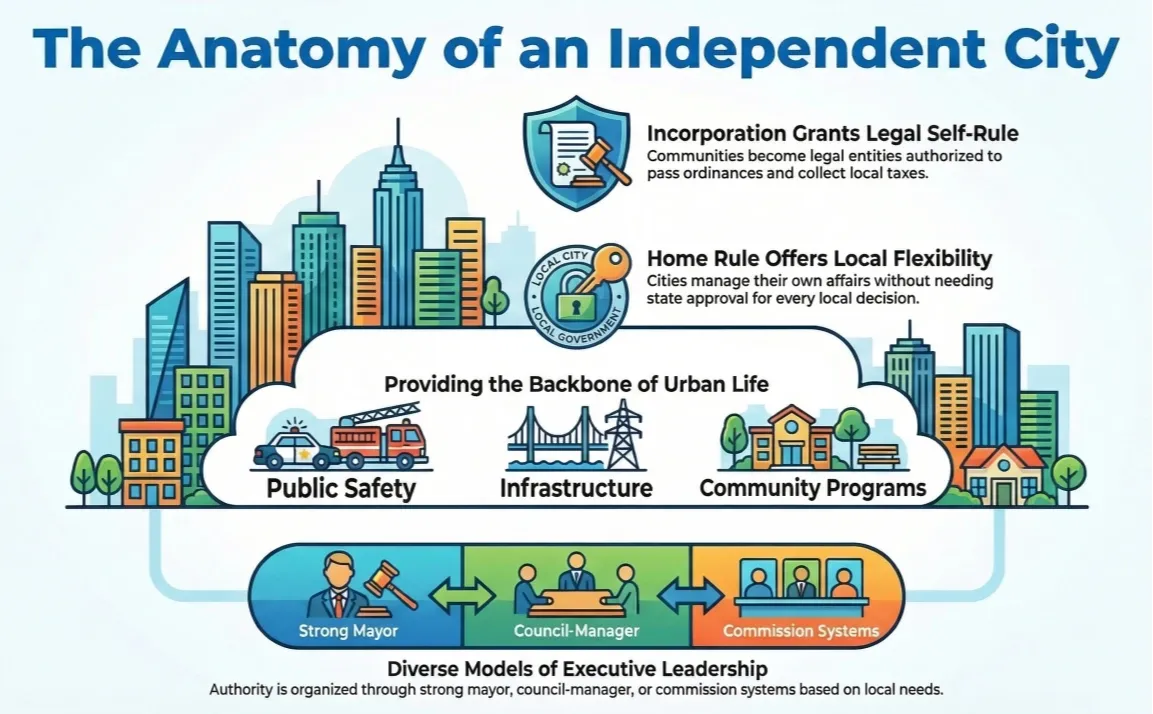
A city becomes an independent unit of local government through a process called incorporation. When a community incorporates, it establishes itself as a legal entity with the authority to govern itself, pass local laws called ordinances, collect taxes, and provide municipal services.
Incorporation requires meeting certain requirements set by state law, such as minimum population thresholds, and is approved by the state government.
Once incorporated, a city has what is called municipal home rule in many states, meaning it has broad authority to manage its own affairs without needing state approval for every decision.
Home rule gives cities the flexibility to respond to local needs and conditions in ways that a one-size-fits-all state policy could not. Cities can establish their own zoning rules, set local tax rates, create their own police departments, and pass ordinances regulating everything from noise levels to building codes.
What City Governments Do
The services provided by city governments are the backbone of urban life. Public safety is typically the largest area of city government responsibility. Police departments maintain order, respond to crimes, and work to keep neighborhoods safe. Fire departments respond to fires and medical emergencies. Many cities also operate emergency medical services.
Infrastructure is another major responsibility. Cities build and maintain local roads and sidewalks, manage traffic signals, operate water and sewer systems, and collect trash and recycling. These services are so routine that most residents only notice them when they fail. For example, a water main break or delayed trash pickup can frustrate many residents.
Cities also provide community services that enhance quality of life. Public parks, recreation centers, libraries, and community programs serve residents of all ages. Many cities operate public transit systems, housing programs, and social services. Some larger cities run their own public hospitals or health departments. The scope of what any given city provides depends on its size, resources, and the preferences of its residents.
City Leadership
Most American cities are governed by an elected city council that serves as the legislative body, passing ordinances and setting the city budget. Beyond that basic structure, cities vary considerably in how executive authority is organized.
Some cities have a strong mayor system, in which a directly elected mayor holds significant executive power, setting policy direction, appointing department heads, and managing city operations. Others use a council-manager system, in which a professional city manager hired by the council handles day-to-day administration while the elected mayor plays a more ceremonial role.
Smaller cities sometimes use a commission system, in which elected commissioners each oversee a specific department and collectively make legislative decisions.
Each model reflects different ideas about democratic accountability and professional management, and cities continue to debate which approach works best for their particular needs and circumstances.