Forms of County Government
County governments across the United States do not all work the same way. Just as cities have developed different models of local government to suit their needs, counties have adopted a variety of structures for organizing their leadership and administration. The form a county government takes can significantly affect how decisions are made, how accountable officials are to residents, and how effectively services are delivered.
The Commission Form
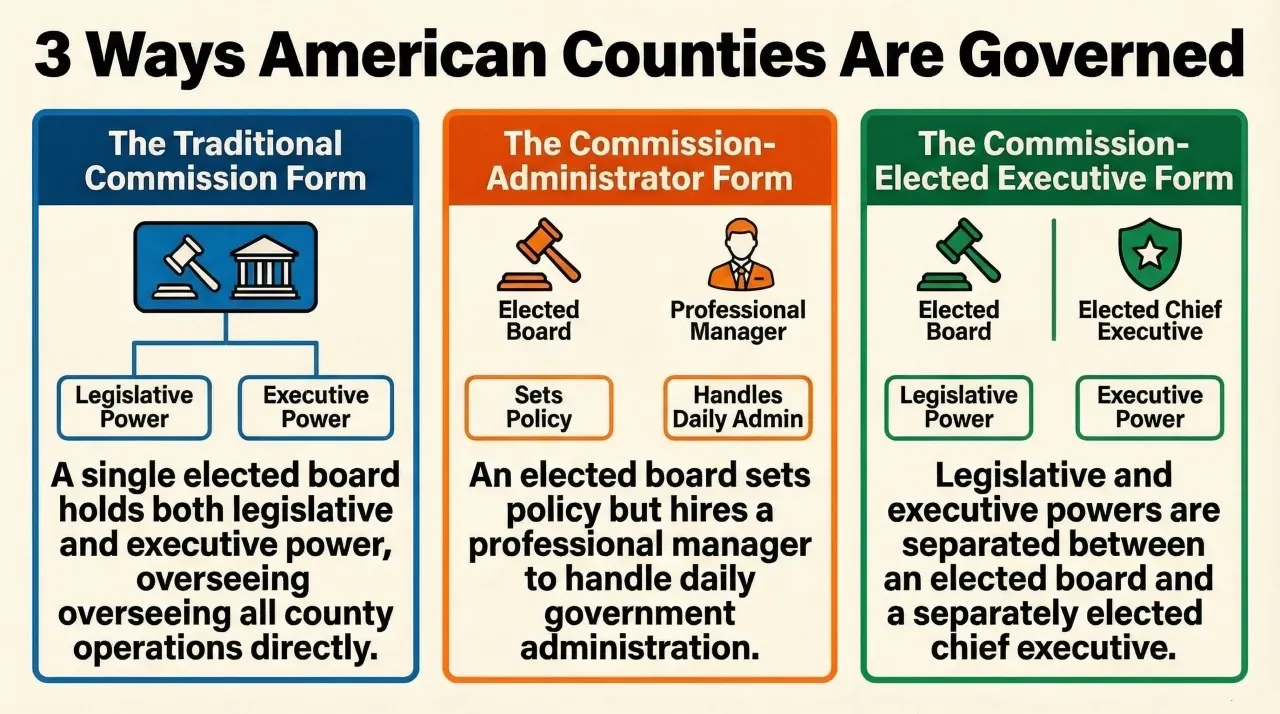
The most common and traditional form of county government is the commission form, used in a majority of American counties. Under this system, an elected board of commissioners serves as both the legislative and executive authority for the county. The commissioners collectively set policy, approve the budget, and oversee county operations. Individual commissioners may also be assigned administrative responsibility for specific county departments.
The commission form has deep historical roots and is valued for its simplicity and the direct accountability it provides. Voters elect the commissioners who make decisions and run the county, with no separation between the people who make the rules and the people who carry them out.
Critics argue that this lack of separation can lead to inefficiency and that commissioners who are primarily politicians may lack the administrative expertise needed to manage complex county operations.
The Commission-Administrator Form
Many counties have modified the traditional commission model by adding a professional administrator to handle day-to-day management. Under the commission-administrator form, an elected board retains legislative and policy-making authority, but hires a professional county administrator or manager to oversee the operations of county government. The administrator implements the board's policies, manages county employees, and brings professional expertise to the running of government services.
This model is popular because it combines democratic accountability through elected commissioners with professional management through an appointed administrator. It mirrors the council-manager model used in many cities and reflects a recognition that running a modern county government requires specialized skills in budgeting, personnel management, and public administration.
The Commission-Elected Executive Form
Some counties have moved toward a model that more closely resembles the structure of state and federal government by creating a separately elected county executive. Under the commission-elected executive form, voters elect both a legislative board and an independent county executive who serves as the chief administrative officer of the county. The executive has the authority to appoint department heads, propose the county budget, and in some cases veto actions of the commission.
This separation of legislative and executive powers within county government provides stronger checks and balances and gives voters a clear, identifiable leader to hold accountable for the overall direction of county government. Larger, more populous counties are more likely to use this model, since their greater complexity and larger budgets may benefit from stronger executive leadership and clearer lines of authority.
Choosing the Right Structure
No single form of county government is right for every situation. Rural counties with small populations and limited budgets may function perfectly well under the traditional commission form, where elected officials can handle both policy and administration without creating an expensive management layer.
Larger, more complex counties with bigger budgets and more responsibilities may benefit from professional management provided by an administrator or an elected executive. State law plays a role as well, since some states mandate or restrict certain forms of county government.
Ultimately, the structure of county government reflects the community's priorities around democratic accountability and the scope of services county residents expect their government to provide.