Town Governments
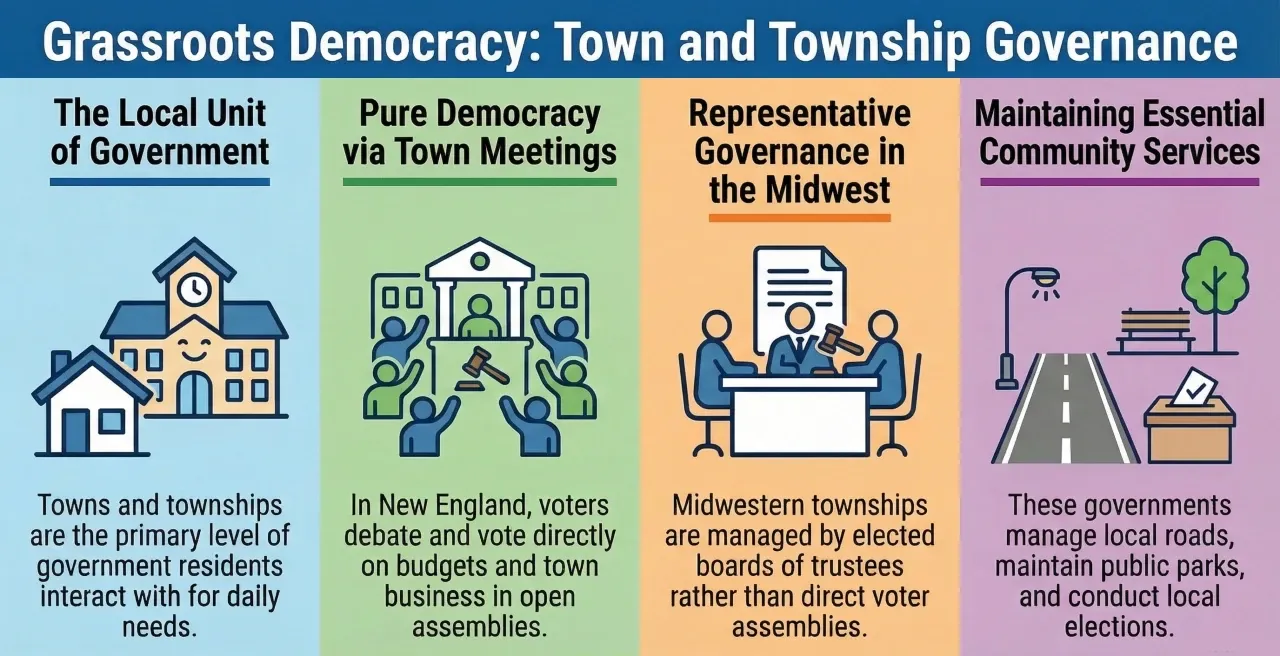
Towns and townships represent some of the oldest and most local forms of democratic government in the United States. In many parts of the country, particularly in New England and the Midwest, towns and townships are the primary unit of local government that residents interact with.
They manage the roads in front of people's homes, maintain local parks, run local elections, and in some cases provide a remarkable degree of direct democratic participation that larger governments simply cannot offer.
What Is a Town?
The definition of a town varies from state to state, which can make the concept confusing. In some states, a town is simply a municipality that is smaller than a city, incorporated in the same way but with a different legal designation.
In New England states like Massachusetts and Connecticut, however, the town is the fundamental unit of local government, and the entire state is divided into towns. There are no unincorporated areas outside of town boundaries. Every piece of land belongs to some town, and every resident is governed by their town.
In the Midwest and Mid-Atlantic states, the comparable unit is often called a township rather than a town. Townships typically cover a defined geographic area, often six miles square based on the original federal land survey system, and provide basic local services to residents both inside and outside any incorporated cities or villages within their boundaries.
The New England Town Meeting
Perhaps the most celebrated form of local democracy in the United States is the New England town meeting. In its traditional form, the town meeting is an assembly open to all registered voters of the town, held annually and sometimes more frequently for special matters.
At the town meeting, residents debate and vote directly on the town budget and other matters of town business. Every voter has the right to speak, ask questions, and cast a vote on each item of business.
The town meeting is often held up as the purest form of direct democracy in American government, a living example of the kind of self-governance that the founders believed was the foundation of a free society.
Thomas Jefferson admired the New England town meeting as a model of civic participation. In practice, attendance at town meetings has declined in many communities as populations have grown and lives have become busier, but the institution remains a meaningful form of civic engagement in hundreds of New England communities.
Larger towns that find it impractical to gather all voters in a single meeting have adopted the representative town meeting model, in which voters elect a larger body of town meeting members to attend and vote on their behalf, while still allowing all residents to attend and speak.
Township Government in the Midwest
Midwestern townships are typically governed by an elected board of trustees, usually three members, along with an elected township clerk and treasurer. The trustees set policy and manage township affairs collectively. Township governments in this region typically provide a more limited range of services than New England towns, focusing primarily on road maintenance, property assessment, and in some areas, cemetery maintenance and basic assistance to residents in need.
In many Midwestern states, the role of township government has diminished over time as counties and cities have taken on more service responsibilities. Some states have debated eliminating townships altogether as an unnecessary layer of government, while others have maintained them as valuable local institutions with deep community roots.
Why Town Government Matters
Whatever form it takes, town and township government represents something important about American democratic values. It is government at its most local and most accessible. The officials who make decisions about the road in front of your house, the zoning of your neighborhood, or the budget of your local parks are your neighbors, often people you see at the grocery store or at school events.
That proximity between governed and governing is one of the defining features of local democracy, and it is one reason why civic engagement at the local level, voting in local elections, attending public meetings, and running for local office, matters as much as participation in state and national politics.