State and Local Issues
State and local governments deal with a wide range of issues that directly affect the daily lives of residents. While debates in Washington often dominate the news, some of the most consequential policy decisions in American life are made in state capitals and city halls.
Education, public safety, infrastructure, land use, and public health are just a few of the areas where state and local governments make choices that shape communities in lasting ways.
Education
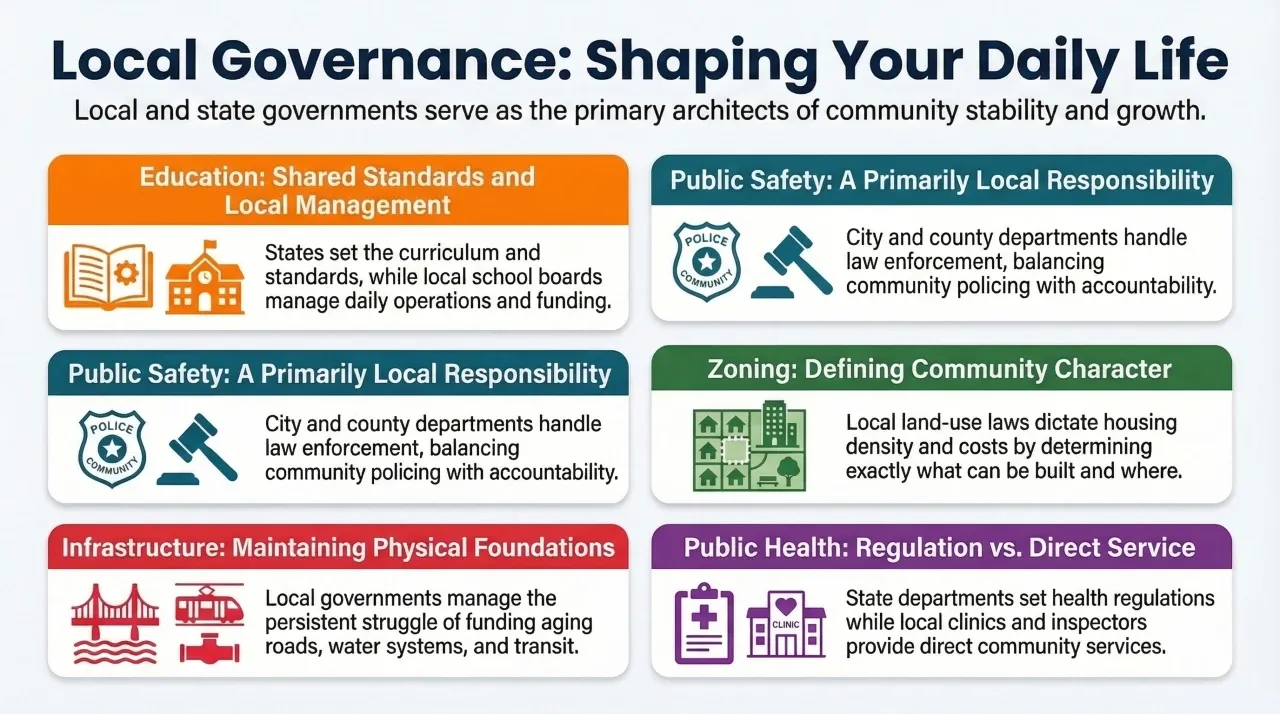
Public education is one of the most important responsibilities of state and local governments. States set educational curriculum and standards and oversee teacher certification. Local school districts, governed by elected school boards, manage the day-to-day operation of public schools, hire teachers, and make decisions about how schools are run.
Funding is one of the most contentious issues in public education. Most public school funding comes from a combination of local property taxes and state aid. This system means that schools in wealthier communities with higher property values tend to have more resources than schools in poorer communities, creating significant inequalities in educational opportunity across different areas. States have grappled for decades with how to distribute education funding more equitably, with varying approaches and results.
Other ongoing debates in education policy include standards and testing, school choice programs, and how to support students with special needs. These debates play out at school board meetings and in local elections across the country.
Public Safety
Policing and public safety are primarily local responsibilities. City and county police departments handle most law enforcement, while state police agencies provide support and cover areas without local police coverage.
Local governments decide how to staff and fund their police departments and how to structure relationships between law enforcement and the communities they serve.
Public safety debates at the local level have intensified in recent years, with communities grappling with questions about police practices, use of force policies, community policing strategies, and how to balance accountability with effective law enforcement.
Local elected officials and community members all play roles in shaping these policies, and the approaches taken can vary dramatically from one community to another.
Infrastructure and Transportation
Roads, bridges, water systems, and public transit are the physical foundations of community life, and maintaining and improving them is a key responsibility of state and local governments. States manage their highway systems, while local governments handle local streets. Water and sewer systems are typically managed by local governments or regional authorities.
Infrastructure represents one of the most straightforward areas of government responsibility. Nearly everyone agrees that roads should be maintained and water should be clean, but funding these systems is a constant challenge.
Infrastructure requires enormous ongoing investment, and finding the money to maintain aging systems while building new ones is a persistent struggle for governments at every level.
Zoning and Land Use
One of the most powerful tools local governments have is the authority to regulate land use through zoning. Zoning laws determine what can be built where, separating residential, commercial, and industrial uses This shapes the physical character of communities.
A decision to allow high-density housing development in one area, or to restrict development in another, can have enormous consequences for housing costs, traffic, environmental quality, and the overall character of a neighborhood.
Zoning decisions are made at the local level, typically by elected or appointed planning boards and zoning commissions, and they are among the most contentious issues in local politics.
Debates about where to allow new housing development, how to accommodate growth while preserving community character, and how to address the housing affordability crisis that affects many communities are played out in local government chambers across the country.
Public Health
State and local governments play a central role in protecting public health. State health departments set and enforce health regulations, license healthcare facilities, track disease outbreaks, and manage public health programs. Local health departments provide more direct services, conducting restaurant inspections, operating vaccination clinics, and responding to local health emergencies.
The COVID-19 pandemic brought the importance of state and local public health systems into sharp focus. Decisions about mask mandates, business closures, school operations, and vaccine distribution were made primarily at the state and local level. The variation in approaches across different states and communities became one of the defining features of the American pandemic response. The experience highlighted both the strengths of decentralized public health decision-making and the challenges it can create when a national response is needed.
Why Local Issues Matter
It is easy to focus on national politics and overlook what happens at the state and local level. But the decisions made by state legislators, county commissioners, city council members, and school board officials have immediate, concrete effects on people's lives in ways that federal policy often does not.
The quality of local schools, the safety of neighborhoods, the condition of roads, the availability of affordable housing, and the responsiveness of local services are all shaped by local government decisions.
Staying informed and engaged at the local level is one of the most meaningful ways citizens can participate in democratic self-governance.