Summer Reading List for History Teachers: 10 Books to Read on Summer Vacation
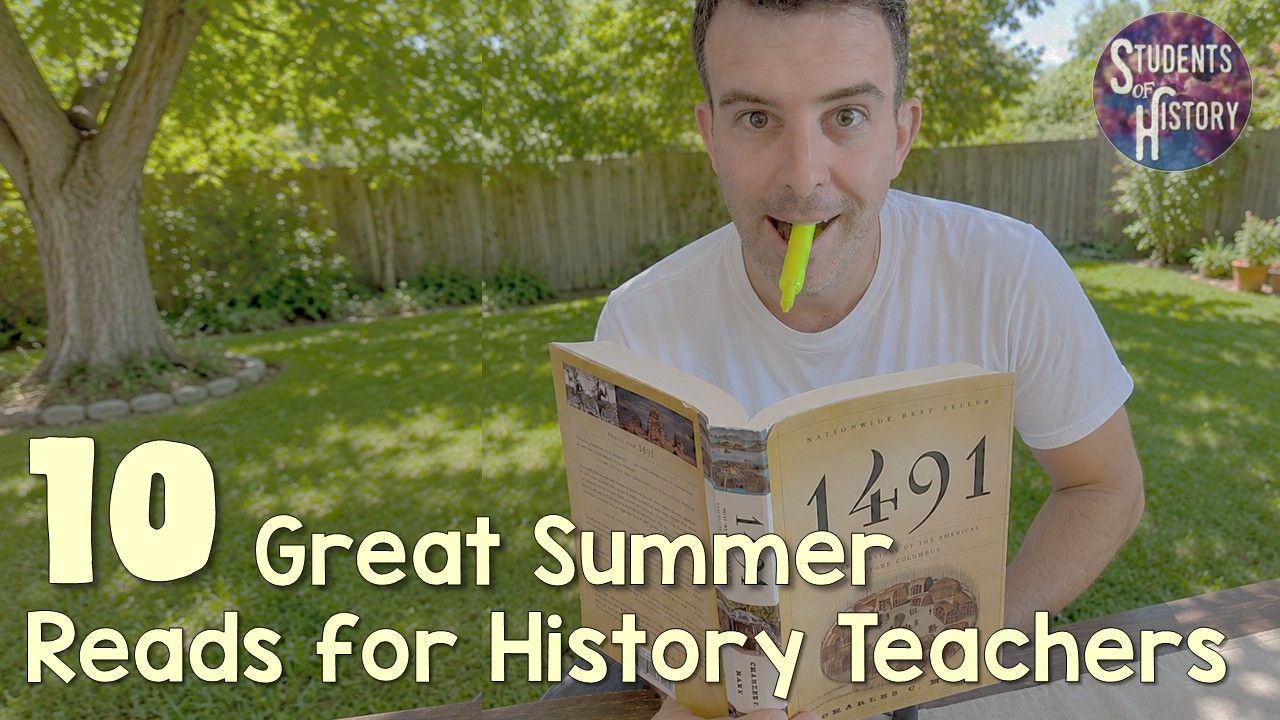
Every summer, I try to pick out a couple history books that can give me some deeper background about the subjects I'll be teaching in the next year. Not textbooks or general US History overviews or anything, but something focused on one single event or person that will make that unit or lesson more interesting for my students.
The best history books don't just fill in gaps in your content knowledge (though they do that, too). They give you stories. Anecdotes. Little moments that make students put down their pencils and lean in. The kind of thing you can't get from a textbook.
Below are 10 books I'd recommend picking up this summer if you teach middle or high school US History or World History. Some are classics. A few are more recent. All of them will give you something to bring into your classroom.
US History Books
1. 1776 by David McCullough
This one's perfect if you teach the American Revolution. McCullough makes the year 1776 feel like a thriller. I love that it so clearly it shows how close the whole thing came to falling apart. Washington's army was demoralized, undersupplied, and outmatched for most of the year.
A great classroom anecdote from this book: After the disastrous Battle of Long Island, Washington orchestrated a nighttime evacuation of 9,000 troops across the East River using fishing boats. A fog rolled in at exactly the right moment and held long enough for them to escape. It's the kind of "wait, did that actually happen?" moment that can generate a great class discussion.
2. Team of Rivals by Doris Kearns Goodwin
This deep dive into Lincoln's presidency and his cabinet is one of the best political books for a general audience. Goodwin's research is extraordinary, and Lincoln comes across as one of the savviest political minds in American history. Not a saint, but a genuinely brilliant operator.
A great classroom anecdote from this book: Lincoln appointed several men to his cabinet who had publicly humiliated him or considered him unqualified for the job. His reasoning was that the country needed the best people available, not the most loyal. That's a surprisingly nuanced leadership lesson that resonates with high school students.
3. The Warmth of Other Suns by Isabel Wilkerson
This is the book I most recommend to US History teachers who want to cover the Great Migration. Wilkerson follows three real people who left the Jim Crow South across different decades and shows how the migration reshaped American cities, culture, and politics.
A great classroom anecdote from this book: One of Wilkerson's subjects, Ida Mae Gladney, left Mississippi after a family member was beaten nearly to death over a bag of pecans. The randomness and brutality of it makes the causes of the Great Migration viscerally real in a way no textbook can replicate.
4. Manhunt: The 12-Day Chase for Lincoln's Killer by James L. Swanson
Another Civil War-era book but a great one. Swanson passed away in 2025 but wrote what might be the most gripping hour-by-hour account in all of American popular history. After Booth shot Lincoln at Ford's Theatre on April 14, 1865, he led Union cavalry on a wild twelve-day chase through the swamps of Maryland and into the forests of Virginia. Swanson reconstructed it from rare archival materials, obscure trial transcripts, and Lincoln's own blood relics. It won the Edgar Award and was adapted into a great miniseries on Apple TV+.
A great classroom anecdote from this book: Booth and his conspirators coordinated simultaneous attacks on Vice President Andrew Johnson and Secretary of State William Seward the same night. Seward was stabbed in his home and only survived because he had on a neck brace from a recent carriage accident.
5. The Devil in the White City by Erik Larson
Technically half true-crime, half history of the 1893 Chicago World's Fair, this one gives some great color to the Gilded Age. Larson weaves together the building of the fair (architecture, innovation, ambition on an almost incomprehensible scale) with the story of a serial killer operating in its shadow.
A great classroom anecdote from this book: The 1893 World's Fair introduced Americans to the dishwasher, the zipper, Juicy Fruit gum, Cracker Jack, alternating current electricity, and the world's first ferris wheel. It was like a preview of the 20th century, compressed into a single summer.
World History Books
6. Sapiens: A Brief History of Humankind by Yuval Noah Harari
You probably know of this one but maybe haven't pulled the trigger to try it yet. Harari takes on all of human history from the cognitive revolution to the present and does it in a way that's genuinely fun to read. Some historians quibble with his broad strokes, but as a way to think about the big themes of World History, there's nothing quite like it.
A great classroom anecdote from this book: Harari argues that the ability to believe in shared myths is what separates us from other animals and is the real engine of civilization. That framing completely changes how students think about what "history" even is.
7. Salt: A World History by Mark Kurlansky
This is the book that proves almost any everyday object, examined closely enough, contains the entire sweep of human history. Kurlansky traces the only rock we eat from ancient China and the Roman Empire through the Civil War and into modern era. He shows how a simple mineral shaped trade routes, financed wars, built empires, and triggered revolutions.
A great classroom anecdote from this book: The word "salary" comes from the Latin salarium - the payment Roman soldiers received to buy salt, which was so valuable it served as currency across the ancient world. Salt tax was one of the key grievances fueling the French Revolution, and in 1930, Gandhi chose a salt march specifically because British taxation of salt hit the poorest Indians hardest.
8. 1491: New Revelations of the Americas Before Columbus by Charles C. Mann
This is the book that changed how I teach pre-Columbian history. Mann brings together decades of research to show that the Americas before European contact were more populous, more sophisticated, and more interconnected than our textbooks acknowledge.
A great classroom anecdote from this book: The Amazon rainforest isn't some pristine wilderness. It's been shaped by human activity over thousands of years. Indigenous peoples cultivated much of what we now call "jungle."
9. The Guns of August by Barbara W. Tuchman
The definitive account of how World War I started. Tuchman won a Pulitzer for this one, and it reads more like a novel than a history text. If you teach WWI, you need it on your shelf.
A great classroom anecdote from this book: The war began, in part, because the military plans of all the major powers were so rigid that once mobilization began, it couldn't be stopped. Leaders who wanted to pause and negotiate found themselves unable to, because their armies were already moving on timetables set years earlier. It's a haunting lesson that resonates with kids who ever felt trapped by a decision they made long ago.
10. Genghis Khan and the Making of the Modern World by Jack Weatherford
Most kids learn about Genghis Khan as a conqueror and destroyer. This book argues instead that the Mongol Empire was one of history's great engines of trade, religious tolerance, and cross-cultural exchange. It's one of the most effective "everything you thought you knew was wrong" books for World History.
A great classroom anecdote from this book: The Mongols created the first international postal system, established the concept of diplomatic immunity, promoted religious freedom across their empire, and connected trade routes from China to Europe that hadn't existed before. The Black Death, which arrived in Europe via those same trade routes, was an unintended consequence of exactly that connectedness. History, as always, is complicated.
A Few Tips for Summer Reading...
I hope one of these 10 books jumps out to you as a good read. I like to pair them with fun, totally unrelated fiction book that's an escape from my content. Recent ones I loved are The Beach by Alex Garland, Recursion by Blake Crouch, and Tomorrow, and Tomorrow, and Tomorrow by Gabrielle Zevin. That gives a great balance of escapism and history in your summer reads.
When you are reading one of these (pr any other historical book), keep a highlighter, your Notes app, or a small notebook nearby. When you read something that stops you mid-page write it down with the book and page number. Those become your secret weapon in October when you need a great hook for a lesson.
And if you want classroom-ready resources that pair with the history these books cover, including lessons on WWI, the Civil Rights movement, the Mongols, and more, check out all my individual resources here or snag an all-access subscription!
Want to try some lessons for free?
Try out some free lesson plans and resources for your social studies classroom!
Don't worry, your information is never shared.