12 Podcast Episodes History Teachers Should Listen to This Summer
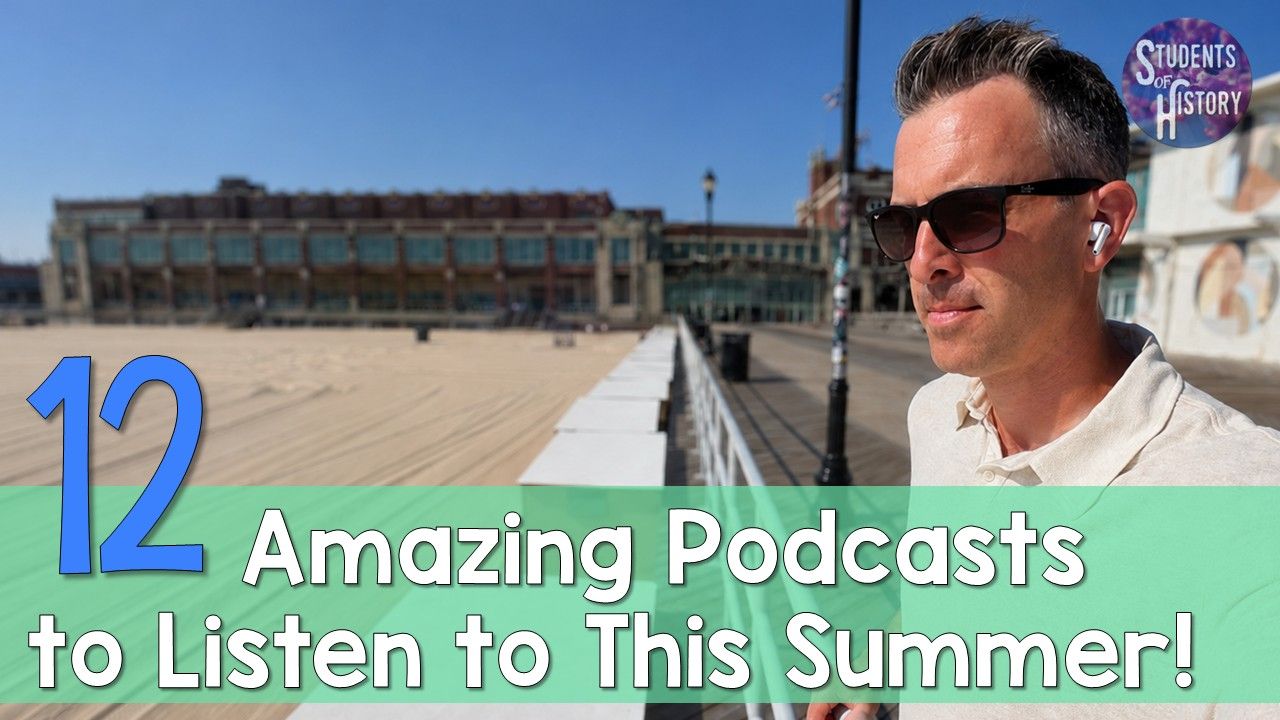
Summer is the time to enjoy history for the pure pleasure of it. No lesson planning, grading, or standards to align to. Just you, a great story, and whatever's in your cup or your earbuds.
Whether you're sitting on the beach, taking a morning walk, driving with the windows down, or just relaxing over coffee before the rest of the house wakes up, a great history podcast is one of the best companions you can have. These are some of my absolute favorites.
Below you'll find entertaining: funny, gripping, and surprising listens that are full of stories and details you simply can't get from a textbook.
Each includes anecdotes that stop you mid-sip, moments that make you rewind, and facts that seem too wild to be true. Background knowledge that deepens how you teach a unit. This will become your secret weapon come September. History teachers are storytellers, and the best stories come from being a curious, engaged learner.
You'll have stories so good your students will put their phones down to hear them. A perspective that changes how you think about a topic you've taught a dozen times.
I've recommended specific episodes rather than just podcast names. No one has time to scroll through 500+ episodes wondering where to start. I've also included lengths so you can match the listen to the moment. Some are perfect for a long beach day. Others fit neatly into a morning walk. All of them are worth your time.
Here we go.
1. Do Go On - "The Münster Rebellion" (Live Episode)
⏱ 1 hour | Available on Spotify, Apple Podcasts, and YouTube
Do Go On is an Australian comedy podcast hosted by comedians Matt Stewart, Jess Perkins, and Dave Warneke. Each episode they take turns researching and sharing a topic. It's like three hilarious friends doing "show and tell" about history.
In this live episode, the trio are on their A-game telling the story of the Münster Rebellion of 1534. A charismatic tailor convinced an entire German city that he was a biblical prophet, seized control, and basically started an apocalyptic cult. The human cages he used to display the bodies of his enemies still hang from the Münster church tower today.
It really captures the chaos of the Protestant Reformation and it's genuinely hilarious in the process.
Also worth listening to from Do Go On: "The Wives of Henry VIII" (1 hr 37 min). You can skip the first 20 minutes of banter if you want (though it's quite funny), and what follows is a comprehensive, entertaining account of Henry VIII's marriages, obsession with succession, and England's religious-political upheaval. Perfect for any World History teacher covering the Reformation era.
Bonus pairing: Dan Carlin's Hardcore History has an episode on the Münster Rebellion called "Prophets of Doom". It covers the same story but in a completely different style: dramatic, thorough, and gripping. The two together are a masterclass in how the same history can be told in entirely different ways.
2. Behind the Bastards - "Christopher Columbus: Bringer of the Apocalypse" (3-Part Episode)
⏱ Part 1: 1 hr 33 min | Part 2: 57 min | Part 3: 1 hr 28 min | Available on Spotify and Apple Podcasts
Behind the Bastards is one of the most popular history podcasts around, hosted by journalist Robert Evans. The format is simple: Evans does deep research on history's most infamous figures and walks a guest who usually knows very little about the subject through what he found.
In this three-part episode, Evans is joined by comedian Michael Swaim for an epic, unflinching examination of Columbus and the full scope of the atrocities he committed in the Caribbean. It goes far beyond what most students (or teachers) learned in school.
This is a great listen for any US History or World History teacher looking to walk into class with a much fuller picture of what the "discovery" of the Americas actually meant for its inhabitants.
3. The Dollop - "Ronald Reagan" with guest Patton Oswalt (2-Part Episode)
⏱ Part 1: 1 hr 39 min | Part 2: 1 hr 29 min | Available on Spotify and Apple Podcasts
The Dollop is one of my favorite comedy/history podcasts. Host Dave Anthony researches a story and presents it to his co-host Gareth Reynolds. Reynolds's reactions and improvised commentary are half the entertainment.
For their landmark 400th episode, they brought in comedian Patton Oswalt as a special guest for a deep dive on Ronald Reagan. It's among the funniest and most informative things I've ever listened to. Oswalt's encyclopedic knowledge of movies, pop culture, and history means he's constantly firing off references as they work through Reagan's showbiz career and then his presidency.
The three of them are simultaneously horrified and hilarious as they learn about Reagan's life and the full sweep of his presidency. For US History teachers covering the 1980s and the conservative movement, this is essential and entertaining listening.
4. The Rest Is History - "Bloodbath at Agincourt" (Part 3 of their Hundred Years War series)
⏱ 51 minutes | Available on Spotify, Apple Podcasts, and with great animations on YouTube
The Rest Is History pairs two real historians (Dominic Sandbrook and Tom Holland) who happen to be charismatic, witty, and just fun to listen to. It's the rare podcast that combines academic depth with the feel of two brilliant friends having a conversation at a pub.
This episode opens with Henry V's famous speech: "We few, we happy few, we band of brothers." It then dives into one of the most extraordinary military upsets in medieval history: the Battle of Agincourt, 1415, where a depleted English army defeated a vastly larger French force. It's perfect for AP World or any World teacher covering the Middle Ages.
You don't need to have listened to the earlier parts of the series to enjoy this one, though going back to parts 1 and 2 is worth your time if you want the full context.
Also worth listening to from The Rest Is History: I love their Ancient Civilizations episodes also - their episode "Greece vs Persia: Battle of Marathon" is fantastic.
5. Snafu with Ed Helms - "The Citizens Commission to Investigate the FBI" (Season 2, Episode 1)
⏱ 32 minutes (series runs 8 episodes) | Available on Spotify & Apple Podcasts
Ed Helms (yep, Andy Bernard from The Office) hosts this meticulously produced podcast about history's greatest screw-ups. Season 2, known as "MEDBURG," covers one of the most extraordinary true stories of the 20th century: a courageous group of ordinary folks who broke into an FBI office in 1971 and exposed J. Edgar Hoover's deepest secrets.
The episode that opens the season is a perfect entry point. What follows across the full eight-episode season is an incredible story of activism, government overreach, surveillance, and the question of when civil disobedience is justified. It's riveting from start to finish and pairs naturally with any Cold War unit covering the domestic surveillance state and the tumultuous politics of the early 1970s.
Start with Episode 1 and see if you can stop there. You probably won't.
6. Evil Genius with Russell Kane - "Joan of Arc"
⏱ 39 minutes | Available on Spotify and Apple Podcasts
This BBC pod has a great premise: host Russell Kane presents a historical figure to a panel and the guests debate whether that person was an evil genius or something else entirely. It's fun, irreverent, and surprisingly illuminating.
In this episode, guests Ola Labib, Edd Hedges, and Lily Phillips must decide: was Joan of Arc a martyr or a loser?
So yes, back to the Hundred Years' War but this one is far sillier than The Rest Is History. It's more of a comedy panel show meets history seminar and fun to see the same era through a different lens. Joan of Arc is one of the most fascinating figures in World History, and the debate format forces you to actually think about the evidence rather than just absorb a narrative.
7. Revisionist History - "The Foot Soldier of Birmingham"
⏱ 34 minutes | Available on Spotify and Apple Podcasts
Malcolm Gladwell's Revisionist History re-examines moments, people, and ideas from the past that have been overlooked or misunderstood. This is one of his best episodes and one of the most powerful single podcast episodes I've encountered for US History teachers.
Birmingham, 1963. The photograph of a police dog viciously attacking a young Black protester becomes one of the most iconic images of the Civil Rights Movement. It shocks the nation and changes the course of history. But Gladwell goes back and asks the people in the photograph what they actually think happened that day. The answer is more complicated, more human, and more interesting than the image alone suggests.
This is a great one for bringing nuance to your Civil Rights unit and at just 34 minutes it's one of the most efficient listens on this list.
8. You're Dead to Me - "Cuneiform"
⏱ 57 minutes | Available on Spotify and Apple Podcasts
BBC's You're Dead to Me is hosted by Greg Jenner and follows a simple format: one historian expert, one comedian, one topic from ancient or world history. It's accessible, well-produced, and perfect for World History teachers who want a quick but substantive deep dive.
This episode brings in Dr. Moudhy Al-Rashid and comedian Phil Wang to explore the world's oldest writing system, developed in ancient Mesopotamia over 5,000 years ago. The clay tablets they left behind recorded everything from beer transactions and legal disputes to lullabies and the world's first epic poem, The Epic of Gilgamesh.
At only 28 minutes this is one of the most efficient listens on the list and it's a great one for teachers covering ancient civilizations and the Fertile Crescent.
9. Code Switch - "The Cruel Story Behind the 'Reverse Freedom Rides'"
⏱ 43 minutes | Available on Spotify and Apple Podcasts
NPR's Code Switch explores race and identity through the lens of history and current events.
In 2022, Republican governors lured migrants into traveling to Massachusetts under false pretenses. But this political stunt had a direct historical precedent: the "Reverse Freedom Rides" of 1962, in which Southern segregationists sent Black families north under similarly deceptive circumstances. The episode traces the history, the parallels, and what both moments reveal about race and politics in America.
This is a great listen for US History teachers who cover the Civil Rights Movement and the Freedom Rides, and want to show students how history echoes into the present. The current events connection makes it especially powerful for discussion.
10. Our Fake History - "Napoleon Bonaparte: Man or Myth?" (2-Part Episode)
⏱ Part 1: 42 min | Part 2: 49 min | Available on Spotify and Apple Podcasts
Our Fake History has a great premise: host Sebastian Major takes famous historical myths and legends and examines which parts are actually true. It's a straightforward, engaging listen with one of my favorite theme songs.
Napoleon is the subject of their first two-part episode. There's just so many myths and stories swirling around him (the height thing, the hand in the coat, his relationship with Josephine) that Major needed extra time to sort fact from fiction. It's a perfect listen for World History teachers who want plenty of great "did you know?" moments for your students.
11. Cautionary Tales with Tim Harford - "How Britain Invented, Then Ignored, Blitzkrieg"
⏱ 36 minutes | Available on Spotify and Apple Podcasts
British journalist Tim Harford hosts this pod that tells stories of catastrophic human error, tragic miscalculations, daring heists, and spectacular fiascos. What sets it apart is the use of voice actors doing dramatic readings of primary sources. It gives each episode a real cinematic quality.
This episode is a perfect example of what the show does best. In 1917, a British major conceived of a revolutionary military strategy. He proposed using newly invented tanks to punch deep behind enemy lines, paralyze logistics, and cause psychological collapse before the enemy could respond. The British military establishment didn't like it. Twenty years later, Nazi Germany adopted those ideas to devastating effect.
It's a gripping episode that resonates well beyond military history for World or US History teachers covering WWI and WW2.
12. Ridiculous History - "History's Weirdest Flexes"
⏱ 31 minutes | Available on Spotify and Apple Podcasts
Ridiculous History is hosted by Ben Bowlin and Noel Brown, with a mission to explore the weirdest, most surprising corners of history. It's approachable, well-researched, and funny.
In this episode, guests Miles and Jack from The Daily Zeitgeist help explore some of the strangest and most ostentatious displays of status and power in history. There's a bunch of great anecdotes here, including Charles Darwin being determined to eat one of every animal he encountered. As the hosts put it, Darwin was basically a reverse Noah's Ark.
Part 1 is only 31 minutes and is packed with bizarre, laugh-out-loud historical anecdotes that make for great classroom hooks. This is the episode you put on during a morning walk and then spend the rest of the day finding excuses to tell people what you just learned.
Also worth listening to from Ridiculous History: I wanted to recommend their episode "Did Knights Really Wear Suits of Armor?" but thought that would be one too many from the Middle Ages. It's a great one though!
This was a hard list to limit to just 12. Actually, if you'll allow me to recommend one more - try the Scapegoat Cities episode on "The Irrepressible Moe Yonemura". It is profoundly moving story of a larger-than-life Japanese American cheerleader during World War 2.
I hope you find some great stuff to listen to here!
As you listen, be sure to have a way to take notes to remember those interesting tidbits you'll want to share later.
Also, don't feel like you have to finish every episode. If one isn't clicking after 20 minutes, move on. There's no homework here.
If you find an episode that you think a colleague would enjoy then send it along! The history teacher community is better when we're all listening to the same things and talking about them.
And if you're looking for classroom-ready resources that pair with the topics these podcasts cover - I've got lessons, projects, videos, and classroom ready resources for every day of the year in World History, US History, Government, and Geography!
Want to try some lessons for free?
Try out some free lesson plans and resources for your social studies classroom!
Don't worry, your information is never shared.