
Bring the Civil Rights Movement to Life: 8 Activities Beyond Rosa Parks & MLK
Mar 15, 2026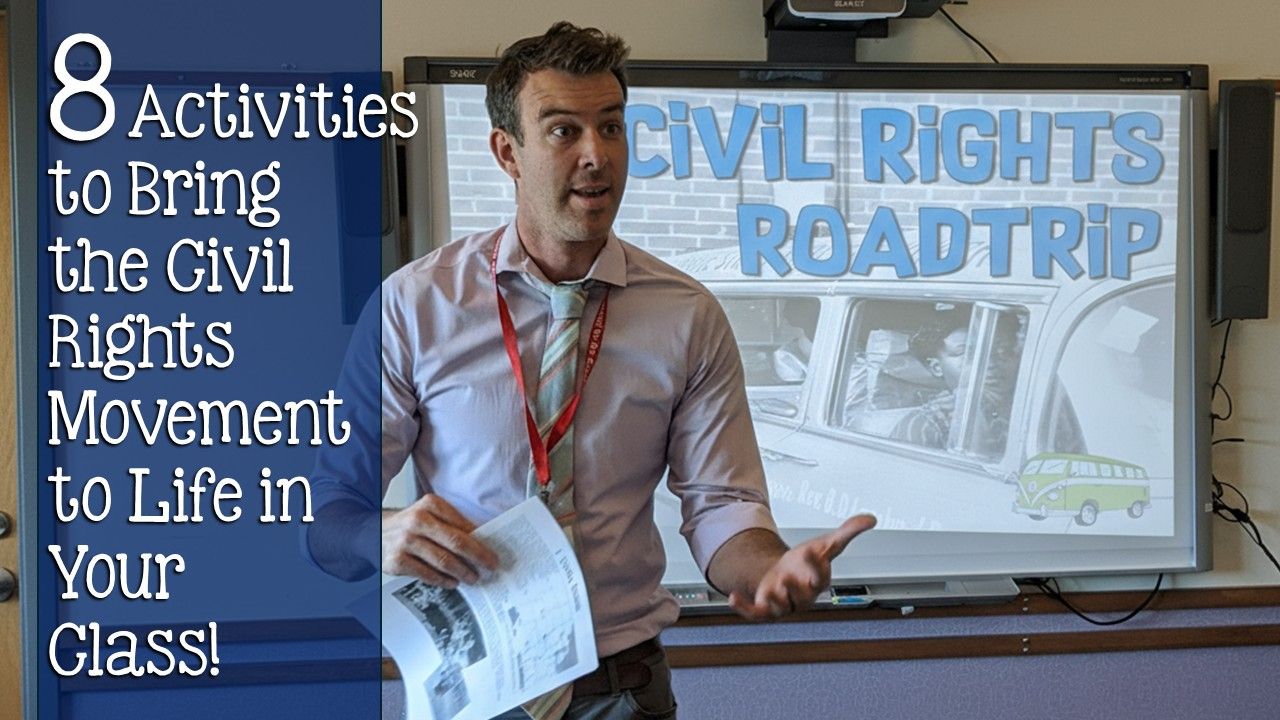
Every U.S. History teacher knows the challenge: you want to do justice to the Civil Rights Movement, but textbooks barely scratch the surface. Yes, Rosa Parks, Martin Luther King Jr., and the March on Washington are essential. But your kids have learned about them already and the movement was SO MUCH bigger than a handful of famous names.
The truth is, the fight for civil rights involved thousands of ordinary people making extraordinary choices. It stretched across decades, across communities, and across causes. And when students discover that broader story, something clicks.
Here are 8 classroom-ready activities that go beyond the usual figures to help your students understand the full scope of the Civil Rights Movement . Who fought, how they fought, and why it still matters today.
1) Green Book Mapping Project
This is one of my all-time favorite activities for helping students feel what segregation actually meant in everyday life.
Students analyze scanned copies of the real Negro Motorist Green Book. This was the travel guide that helped African Americans find safe places to eat, sleep, and fill up their tanks during the Jim Crow Era. Then they use it to plan a road trip, restricted to only the hotels, restaurants, and gas stations listed in the guide.
After mapping out their route, students reflect on the stress and hardship that segregation placed on Black travelers. It's a simple premise that lands with real emotional weight. I love pairing this one with a discussion about the 2018 Academy Award-winning film Green Book, which can be a good one to show in class if you have time!

2) Civil Rights Activists & Allies: Biographies, Activities & Project
This is the ultimate "beyond the textbook" resource for the Civil Rights Movement.
The download includes 25 short biographies of activists and allies your students likely haven't heard of. People like Carl and Anne Braden, Viola Liuzzo, Yuri Kochiyama, Larry Itliong, and Joan Trumpauer Mulholland. Americans from all walks of life who risked everything for justice.
What I love about this one is the variety of activities included. There's a "Find Someone Who…" collaboration activity that gets kids moving around the room, an Honorary Plaque project, and my personal favorite: the Activists & Allies Dinner Party assignment, where students connect historical figures based on shared values and causes. It sparks great conversation and really deepens understanding.
It's a no-prep, ready-to-go lesson that works perfectly as part of your Civil Rights unit, for Black History Month, or anytime you want to amplify voices that don't usually make it into the curriculum.
3) Stonewall Uprising & LGBTQ History Lesson
The Civil Rights Movement inspired and overlapped with many others. This lesson brings the LGBTQ rights movement into your U.S. History classroom through a powerful primary and secondary source analysis.
Students work through 10 sources spanning from 1887 all the way through the 1969 uprising at the Stonewall Inn. The sources trace causes of the uprising — including the arrest of William Dorsey Swann in the 1880s, laws criminalizing homosexuality, and government-sanctioned firings... and then cover the uprising itself through firsthand accounts of figures like Marsha P. Johnson and Stormé DeLarverie.
After the source analysis, students build a timeline of major LGBTQ rights milestones, from the election of Harvey Milk through Obergefell v. Hodges. It's a thoughtful, evidence-based lesson that expands your students' understanding of what the fight for civil rights has looked like across American history.
4) Redlining, Discrimination & the Fair Housing Act
Most students have never heard of redlining. Once they learn about it, they can't unsee it.
This lesson plan uses primary and secondary sources to help students understand how the Federal Housing Administration and the Home Owners' Loan Corporation mapped American cities and systematically denied federally insured mortgages to Black families. Combined with racially restrictive covenants, these policies locked African Americans out of homeownership and wealth-building for generations.
Students analyze 6 actual redlined city maps alongside 13 primary and secondary sources, including restrictive covenants, advertisements, and images. They then connect it all to the 1968 Fair Housing Act.
This one is especially powerful because it connects the Civil Rights Movement to issues students see playing out in the news and in their own communities today. The discussion it sparks is always one of the richest of the year.
5) Cesar Chavez Primary Source Activity
The Civil Rights Movement extended well beyond the Black freedom struggle. Cesar Chavez is one of the most important figures students often miss entirely.
This activity centers on a primary source excerpt from one of Chavez's most famous speeches, in which he reflects on the lessons he took from Martin Luther King Jr. Students analyze the speech, respond to critical thinking questions, and then compare Chavez and King through an interactive notebook activity.
I love using this one because it helps students see the connections between different civil rights struggles and broadens their understanding of who fought for equality in America. It also works beautifully for any unit that touches on labor rights, the Chicano movement, or the 1960s more broadly.
6) Native American Rights & the Alcatraz Occupation
Here's another lesson that expands the Civil Rights story in a direction most textbooks overlook entirely.
In 1969, American Indian activists occupied Alcatraz Island for 19 months, invoking an 1868 treaty and demanding recognition of Native sovereignty. This lesson uses a secondary source article and the actual Alcatraz Proclamation primary source to help students understand both the occupation and the long history of broken promises behind it.
What makes this resource especially rich is the additional readings that connect the occupation to four key historical events: the Purchase of Manhattan Island, the Trail of Tears, the Battle of Little Bighorn, and the Massacre at Wounded Knee. Students trace the thread of injustice across centuries and see the occupation in its full historical context.
It's a powerful way to extend your Civil Rights unit and connect the struggle for equality to Native American history.
7) Civil Rights Resistance Activity: Protest, Collaborate, or Ignore?
This is one of those activities that gets students genuinely wrestling with hard questions.
Students read about 8 key moments from the Civil Rights Movement — including the murder of Emmett Till, the bombing of the Freedom Riders' bus, the Birmingham Campaign, the 16th Street Baptist Church bombing, and the Selma March. After each reading, they decide: Would you have protested? Collaborated with the government? Or tried to ignore it and go on with your life?
After working through all 8 events, students step back and analyze what their choices say about resistance, complicity, and the personal cost of standing up for justice.
This one sparks some of the most honest and meaningful discussions I've seen in a history classroom. It asks students to put themselves in the shoes of real people facing impossible choices — and that's when history really comes alive.
8) Civil Rights Movement Road Trip Map Project
Inspired by the Freedom Riders, this activity is a fantastic way to get students moving around the room while building a geographic understanding of the Civil Rights Movement.
Students rotate around the classroom, stopping at 7 stations with one-page readings on major events: Brown v. Board of Education, the Little Rock Nine, the Montgomery Bus Boycott, and more. At each stop, they complete a graphic organizer and map the event's location.
At the end, students create a digital postcard reflecting on their "road trip" through civil rights history. I love this one because it makes the geography of the movement visible — students start to see patterns in where events happened and why, which deepens their historical understanding.
It works great as a whole-class activity, in small groups, or even as a student-led presentation format.
Bring the Full Story into Your Classroom
The Civil Rights Movement was one of the most complex, courageous, and far-reaching struggles in American history. These 8 resources help your students explore it in all its depth — from the Green Book to Alcatraz, from housing discrimination to the Stonewall Uprising.
Each one is classroom-ready, comes with printable and Google Doc versions, and is designed to get students thinking critically, moving, and making real connections to history.
And remember: if you want access to all of these lessons (and every other resource for U.S. History, World History, Geography, or Government), you can get everything through a Students of History subscription. Choose a monthly or annual plan and unlock your full curriculum today.
Ready to save hundreds of hours on planning?
Gain immediate access to every unit, complete lesson plans, and interactive activities.
Free Lesson Plans & Resources
Interested in some free activities? Sign up to have free sample resources emailed to you!
Never any spam. Unsubscribe any time.