How to Teach Controversial Issues in Your History Classroom
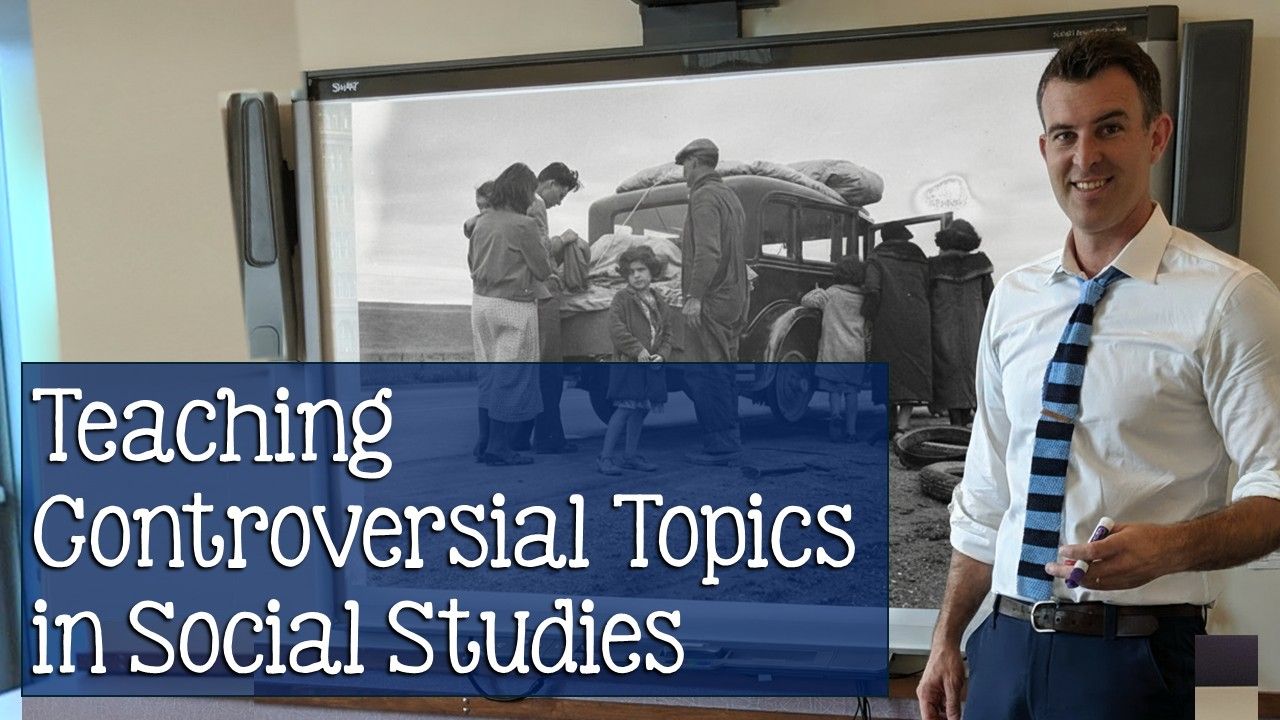
A few years ago, I created a lesson on the Philippines after the Spanish-American War. I had Filipino students in my class, and I kept thinking: their history is in this curriculum, but they'll never see it if I don't teach it. It wasn't in the standards. It wasn't in the textbook. But it was real, it was important, and it belonged in my classroom.
After teaching that lesson, a student came up to me and said something I've never forgotten. He told me he really appreciated me teaching topics that weren't in the textbook. History that really happened and was meaningful for his community. That moment reminded me exactly why I teach history the way I do.
Teaching controversial or difficult history can feel risky. You worry about parent pushback, administrative concerns, or losing control of a classroom discussion. But when you approach these topics thoughtfully and give students real primary sources to work with, something powerful happens. Students stop being passive recipients of history and start becoming active thinkers. They see themselves in the story. And they realize that history is about understanding the world they live in right now.
Here's how I approach teaching controversial issues and topics, along with some of the specific lessons I've found most effective.
Start With a Primary Source, Not Your Opinion
The single most important thing I've learned about teaching controversial issues is this: let the sources do the heavy lifting. Your job isn't to tell students what to think — it's to give them the evidence and tools to think for themselves.
Primary sources are your best friend here. They put students directly in contact with real voices from history, which immediately shifts the dynamic. Instead of debating whether something was right or wrong in the abstract, students are analyzing what real people said, thought, and experienced.
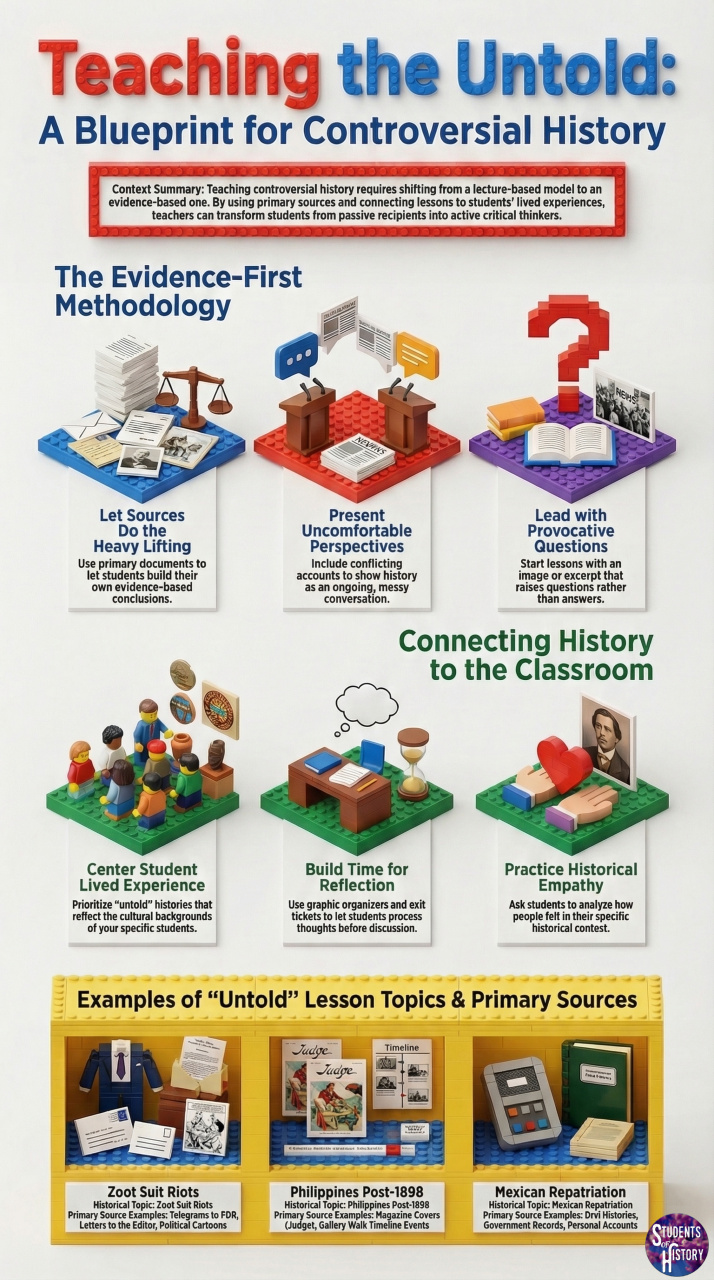
Take the Zoot Suit Riots lesson. Rather than lecturing about racism and wartime discrimination, students analyze 11 primary and secondary sources: newspaper accounts, a telegram sent directly to President Roosevelt, Letters to the Editor with sharply differing viewpoints, photographs, and political cartoons. Students use these to build a cause/event/effect graphic organizer entirely from evidence they've examined themselves.
That structure matters. Students aren't being told "this was racist" - they're reading Eleanor Roosevelt's response to the riots and comparing it to letters from servicemen defending the attacks. They're forming their own conclusions, which makes the learning stick.
Practical tip: When you introduce a controversial topic, lead with a source that raises questions rather than one that delivers answers. A provocative image or a short excerpt with competing interpretations is a much better entry point than an explanation of what happened.
Choose Topics That Connect to Students' Lived Experience
The most impactful lessons I've taught are ones where students recognize their own history in the material — history they knew existed but had never seen taught in school.
When I created the Philippines After the Spanish-American War lesson, I designed it around a gallery walk activity. Seven events are posted around the room, and students move through them to build a timeline tracking whether each event moved the Philippines closer to independence or deeper under American control. We open with a 1899 Judge Magazine cover depicting President McKinley bathing a Filipino figure labeled "Civilization" - a viscerally uncomfortable image that immediately generates honest conversation about racialization, imperialism, and how colonized peoples were portrayed in American media.
This is not an easy topic. It requires acknowledging that the United States acted as an imperial power, that the colonization of the Philippines involved racial propaganda, and that Filipino history is deeply entangled with American history. But that's exactly why it's worth teaching. For students with Filipino heritage, it's often the first time they've seen their community's history treated as something worth learning in school. For all students, it opens a window into the complexity of American foreign policy that a textbook chapter on the Spanish-American War simply doesn't provide.
Similarly, the Mexican Repatriation lesson asks students to grapple with the fact that between 400,000 and 2 million people (the majority of them U.S. citizens) were deported or pressured to leave the United States during the Great Depression. This is history that directly affects many of our students' families and communities, and it is almost never in the standards. Teaching it sends a message: your history matters here.
Practical tip: Survey your classroom before the school year. Knowing the cultural backgrounds of your students helps you identify whose stories are missing from your curriculum. It also gives the opportunity to make a genuine connection.
Give Students Multiple Perspectives, Including Uncomfortable Ones
History is messy. Real events involve people who held sharply different views, and those views were shaped by real circumstances. When we present only one side of a controversial event, we're not really teaching history. We're teaching a morality tale. Students can tell the difference, and it makes them trust the material less.
The Zoot Suit Riots lesson handles this particularly well. Students read Eleanor Roosevelt arguing that long-standing racial discrimination was the root cause of the riots. They also read a letter from a serviceman who framed the violence as a justified response to wartime unfairness. Both are real voices. Neither is edited to be more comfortable. Students have to sit with both and decide for themselves what the evidence suggests.
The same approach runs through the Philippines lesson. Students evaluate each event on the timeline and determine whether it represents genuine progress toward independence or just the appearance of it. The lesson explicitly notes that historians disagree about these questions, which is itself an important lesson: history isn't a fixed set of facts, it's an ongoing conversation about evidence.
Practical tip: The "Letters to the Editor" format is a low-barrier way to introduce multiple perspectives on any controversial topic. It's an authentic source type students recognize, it models disagreement in a civil format, and it shows that ordinary people (not just famous figures) had opinions and a voice.
Build in Time for Reflection, Not Just Discussion
Discussion is great, but it can also go sideways quickly if students don't have time to process what they're thinking before they say it out loud. Building in structured reflection time before class discussion gives students (especially quieter ones) a chance to organize their thoughts and feel more confident participating.
In the Zoot Suit Riots lesson, students complete the cause/event/effect organizer before any full-class discussion. In the Philippines lesson, students build their timeline independently during the gallery walk, then create a political cartoon to represent one of the events before sharing with the class. These steps create space between the evidence and the conversation, which tends to make the conversation more substantive.
One of my favorite reflection prompts for controversial topics: How do you think most [any group] felt about this at the time? How might that differ from how we see it today? This question asks students to practice historical empathy. That means understanding that people in the past operated within a different context. But students should never need to defend positions they may not agree with.
Practical tip: Exit tickets work beautifully after controversial lessons. A simple three-question slip: What was the most surprising thing you learned? What question do you still have? What connection can you make to something in the world today? This gives you valuable insight into where students landed and what follow-up might be needed.
Expand the Standard Curriculum Intentionally
One of the most powerful things you can do as a history teacher is go beyond the standards. Not to be provocative, but because the standards simply don't capture the full story of who we are as a country.
The LGBTQ History and Stonewall Uprising lesson wasn't something I was required to teach. Neither was the Philippines lesson. Neither was Mexican Repatriation. But these topics are real history. They happened. They affected real people — including people who are sitting in our classrooms right now. And when we leave them out, we're telling certain students that their history doesn't count.
The response I've gotten from students on these lessons has consistently reinforced this belief. When students encounter history that speaks to their identity, their heritage, or their community... history that they've never seen in a textbook. Something changes. They lean in. They ask better questions. They care more.
That doesn't mean teaching everything without structure or preparation. It means being intentional: choosing topics that expand students' understanding of who America has been, pairing them with strong primary sources, and giving students the space to think critically rather than simply absorb a narrative.
Practical tip: You don't have to overhaul your entire curriculum. Start with one lesson per unit that takes your students somewhere the textbook doesn't go. A single well-designed lesson on redlining, the Philippines, the Zoot Suit Riots, or the Repatriation can shift a student's entire relationship to the course.
A Final Thought
The best teaching I've ever done has happened in the uncomfortable spaces. The lessons where the topic was hard, the primary sources were disturbing, and the conversation pushed students to wrestle with real complexity. That's where history comes alive.
You're not just teaching content. You're teaching students that the past is complicated, that evidence matters, and that understanding history means taking seriously the experiences of people who don't always make it into the standard narrative.
That's worth some discomfort.
Looking for ready-to-use lessons on these topics? All of the resources mentioned in this post are available through the Students of History subscription! It gives you immediate access to 700+ lessons for either US History, World History, Civics, and Geography, along with daily lesson plans for every day of the school year.
Want to try some lessons for free?
Try out some free lesson plans and resources for your social studies classroom!
Don't worry, your information is never shared.