Great Depression and New Deal Activities for the Classroom
The Great Depression is one of those units that has everything: economic collapse, environmental disaster, political drama, human suffering, and one of the most ambitious government experiments in American history. It's a story that should captivate students. With the right resources, it absolutely does.
The challenge is helping kids connect with a world that feels so distant from their own. Bread lines, Dust Bowl refugees, alphabet agencies... these things don't mean much until students see a face or hear a voice from that era. That's where hands-on activities, primary sources, and creative projects make all the difference.
Here are 7 teacher-approved resources to help bring the Great Depression and New Deal to life in your middle or high school U.S. History classroom.
1) Great Depression & Mexican Repatriation Lesson Plan
This is one of the most powerful and overlooked stories of the entire Depression era and one I always make sure to include in my unit.
Between 400,000 and 2,000,000 people were deported to Mexico in the early years of the Depression, and an estimated 60% of them were American citizens. This lesson uses 8 primary and secondary sources (photos, newspaper articles, and quotes) to help students understand the scope of what happened, why it was controversial, and whether it was even legal.
Students analyze the sources individually or through stations and work toward answering a central essential question based on the evidence. The discussion that follows is always one of the richest of the unit. It's a great reminder that the Depression's hardships didn't fall equally on everyone.
2) Great Depression Interactive Notebook
If you want your students actively engaged during note-taking, instead of passively copying from the board, this interactive notebook set is for you.
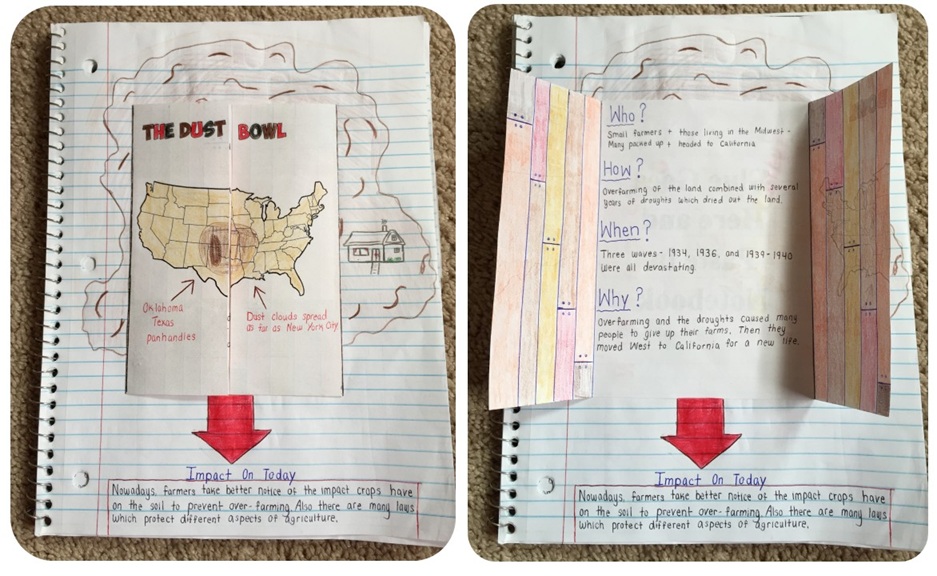
The download includes 7 pages of foldable-style graphic organizers, maps, and creative activities covering all the major topics: the Stock Market Crash, the Dust Bowl, FDR's fireside chats, unemployment data, the New Deal's relief/reform/recovery framework, and the alphabet agencies.
Answer keys and completed sample pages are included so you know exactly what a finished product should look like. I love using these because students end up with a genuinely useful study tool they can reference all unit long.
3) Prohibition and the 18th Amendment Lesson
Prohibition is the perfect bridge between the Roaring 20s and the Depression era and students are always fascinated by it.
This complete lesson runs from warm-up to exit ticket. Students start with an image analysis activity, then work through a secondary source reading and video links before diving into 10 primary source images and documents. Their job is to figure out whether each source argues for or against Prohibition and explain why.
By the end, students have built a nuanced understanding of why Prohibition failed and why the 21st Amendment repealed it. It's also a fantastic lesson for practicing source analysis skills in a context that genuinely grabs student interest. Speakeasies and gangsters have a way of doing that.
4) Letter from a Dust Bowl Survivor
Sometimes the most effective history lesson is a single, well-chosen primary source. This is one of those.
This vivid firsthand letter from a Dust Bowl survivor puts students right in the middle of one of the worst environmental disasters in American history. It's written at a level that middle and high school students can genuinely connect with. It hits differently than any textbook description.
Eight comprehension and critical thinking questions accompany the letter to guide students through the reading and spark class discussion. I like to use this one early in the unit as a hook, before we get into the broader political story of the New Deal. It reminds students that behind all the policy debates were real people living through something unimaginable.
5) New Deal Agencies Analysis & Project
The "alphabet soup" agencies of the New Deal are notoriously hard for students to keep straight. This activity fixes that.
Students read brief overviews of nine key agencies, match each to its abbreviation, and categorize it as relief, reform, or recovery. It's a structured but engaging way to make sense of what can feel like an overwhelming list.
The best part: after completing the analysis, students create their own cartoon or poster promoting one of the agencies. It's a creative, low-stakes project that reinforces understanding while giving students some ownership over the content. The Google Docs version also includes links to online resources so students can dig deeper into whichever agency they choose.
6) The Great Depression and New Deal PowerPoint
Every unit needs a solid foundation, and this 35+ slide PowerPoint is one of the best ways to lay it.
It covers the full arc of the era. From the Stock Market Crash of 1929 and the bank failures through Hoover's response, FDR's election, and the New Deal programs. Plus it's got amazing visuals, animations, and embedded videos to keep students engaged. Guided notes pages are included so students stay focused and capture the key ideas as you go.
There's also a fully narrated flipped classroom video version, which is perfect for homework, absent students, or hybrid learning. This one saves a lot of prep time while still delivering a really compelling lesson.
7) Great Depression & New Deal Unit Plan Bundle
If you want your ENTIRE UNIT planned out from day one, this bundle is the way to go.
It includes more than 30 activities organized with daily lesson plans for a full three-week unit — everything from the PowerPoint and interactive notebooks to a Stock Market Simulation Project, FDR Fireside Chat primary source analysis, the Mexican Repatriation lesson, a Huey Long and Share Our Wealth lesson, and an editable unit test.
Everything is numbered so you know exactly how it fits together, and every resource comes in both print and Google Docs versions. It's one of those purchases that pays for itself in saved planning time many times over.
Make the 1930s Unforgettable
The Great Depression and New Deal is one of those units that teaches students something bigger than just history. It's about how a country responds to crisis, who gets left out, and what government can and can't do for its people. Those are questions that never go out of date.
Whether you use one of these resources or all seven, your students are going to leave this unit with a much deeper understanding of one of the most consequential decades in American history.
And if you want access to all of these lessons plus everything else for U.S. History, World History, Geography, and Government, check out a Students of History subscription. Everything you need for the whole year, all in one place.
Want to try some lessons for free?
Try out some free lesson plans and resources for your social studies classroom!
Don't worry, your information is never shared.